

The History of Diyarbakır: Exploring the Ancient Heart of Mesopotamia
Nestled on the banks of the Tigris River in southeastern Turkey, Diyarbakır is one of the oldest continuously inhabited cities in the world. Known as the “Heart of Mesopotamia,” this remarkable city has witnessed the rise and fall of countless civilizations over more than 10,000 years of history. Its legendary city walls, ancient architecture, and deep cultural roots make Diyarbakır a living open-air museum—a place where every stone tells a story.
Ancient Origins: From Neolithic Settlements to the City of Amida
The roots of Diyarbakır stretch back to the Neolithic Age (around 10,000 BCE). Just a short distance from the city lies Çayönü Tepesi, one of the earliest known farming villages in human history. Archaeological findings from this site reveal humanity’s first steps toward agriculture, architecture, and community life—making Diyarbakır a crucial part of the Cradle of Civilization.
The ancient city was originally known as Amida. By the 3rd millennium BCE, Amida was already a thriving urban center that saw influences from the Hurrians, Assyrians, Arameans, and Urartians. Its strategic position on trade routes connecting Anatolia, Persia, and Mesopotamia made it a vital economic and cultural hub.
Roman and Byzantine Eras: The Birth of the Diyarbakır City Walls
During the Roman Empire, Amida was transformed into a powerful military fortress guarding the empire’s eastern frontier. In 349 CE, Roman engineers constructed the now-famous Diyarbakır City Walls, one of the most impressive examples of ancient fortification in the world.
Built from dark black basalt stone, the walls stretch nearly 6 kilometers and feature 82 towers, 16 gates, and detailed inscriptions celebrating Roman emperors. These fortifications not only protected the city from invasions but also symbolized its strength and prestige.
Under Byzantine rule, Diyarbakır continued to flourish as a religious and administrative center. Early Christian communities built churches and monasteries that turned the city into a center of theological learning and spirituality.
The Islamic Conquest and Medieval Golden Age
In 639 CE, Diyarbakır was conquered by Muslim armies under the Rashidun Caliphate, marking the beginning of a new cultural era. Over the following centuries, the city was ruled by the Umayyads, Abbasids, Marwanids, Artuqids, and Ayyubids—each leaving their unique mark on its architecture and society.
The Great Mosque of Diyarbakır (Ulu Cami), built in the 11th century, stands as one of the oldest mosques in Anatolia. Inspired by the Umayyad Mosque in Damascus, it is a masterpiece of Islamic architecture with intricate carvings and basalt stone design. The mosque continues to be a symbol of Diyarbakır’s religious and cultural diversity.
During the Artuqid period, Diyarbakır experienced an artistic and architectural renaissance. Magnificent madrasas, caravanserais, and bridges were built, and the city became a center for scholars, poets, and craftsmen. Its position on key trade routes allowed it to prosper as a link between the Middle East and Anatolia.
Ottoman Period: The Cultural Crossroads of Anatolia
In 1515, Diyarbakır became part of the Ottoman Empire under Sultan Selim I. The Ottomans made it the capital of a large province that included parts of modern-day Iraq and Syria. Diyarbakır quickly developed into a multi-ethnic, multi-religious metropolis, where Kurds, Turks, Armenians, Arabs, and Assyrians lived side by side.
The Ottomans invested heavily in urban development, building bazaars, inns (hans), mosques, bridges, and public baths (hammams). The city’s unique basalt architecture flourished during this era, giving Diyarbakır its signature black-and-white aesthetic that still defines its skyline today.
Modern Diyarbakır: A Living World Heritage Site
In recognition of its outstanding historical value, the Diyarbakır Fortress and Hevsel Gardens Cultural Landscape was added to the UNESCO World Heritage List in 2015. This designation highlights the city’s unmatched continuity of human settlement and the symbiotic relationship between nature and urban life.
The Hevsel Gardens, stretching between the city walls and the Tigris River, have supplied the city with food and water for thousands of years. They represent one of the oldest examples of sustainable agricultural practice in human history.
Modern Diyarbakır continues to blend ancient heritage with contemporary life. Visitors can explore:
-
The Diyarbakır City Walls and gates such as Dağ Kapı and Mardin Kapı
-
The Great Mosque (Ulu Cami)
-
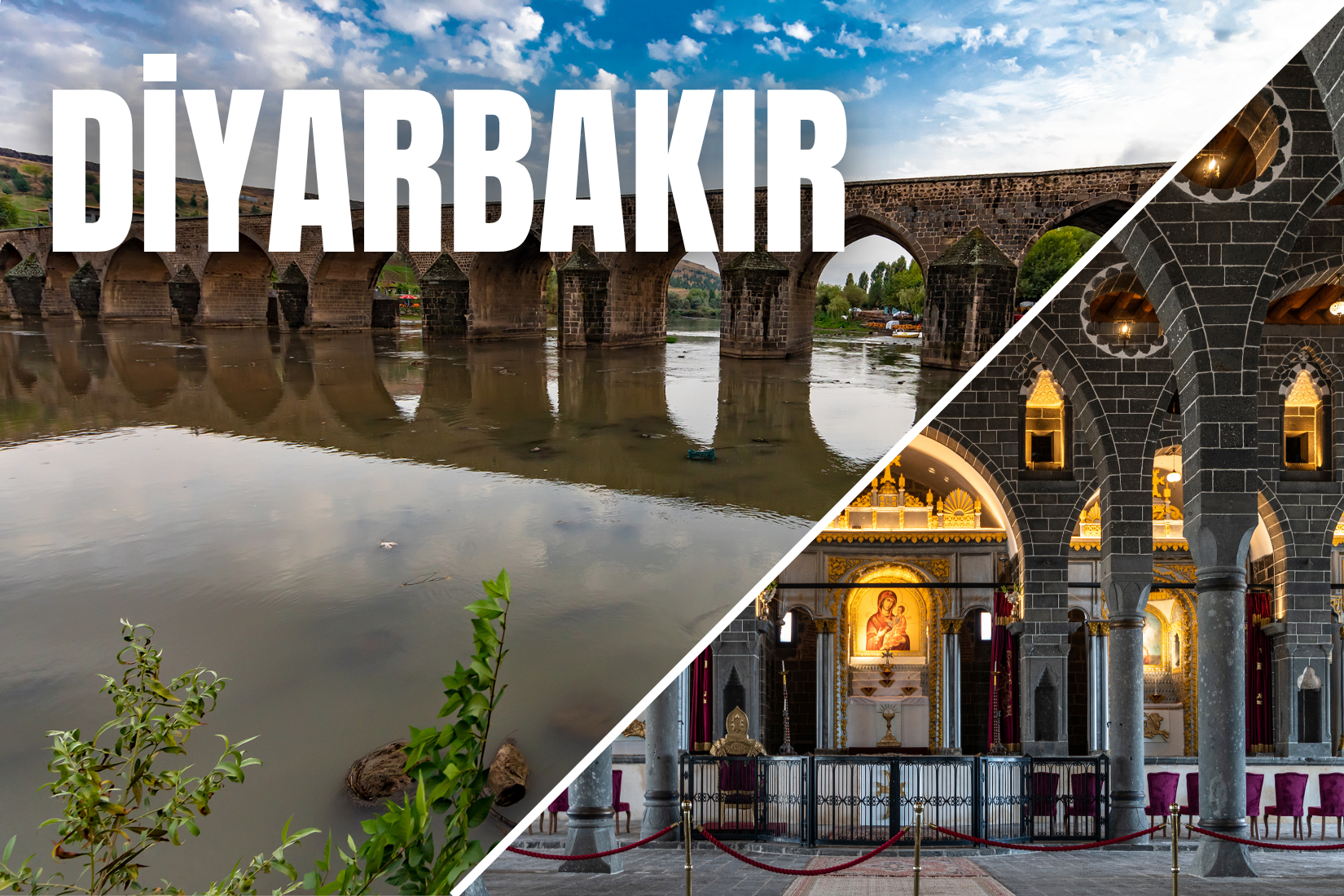
The Virgin Mary Syriac Church
-
The Hasan Paşa Hanı and Deliller Hanı, now converted into boutique hotels and cafés
-
The On Gözlü Köprü (Ten-Arched Bridge) spanning the Tigris River
These landmarks reflect the city’s layered history and its ongoing role as a meeting point of cultures.
Cultural Heritage, Music, and Cuisine
Beyond its monuments, Diyarbakır is famous for its rich cultural traditions. The city’s folk songs and dengbêj performances (oral storytelling) are integral to Kurdish cultural identity, expressing themes of love, exile, and endurance.
Its cuisine is equally diverse, combining Mesopotamian, Turkish, and Arabic influences. Dishes like kaburga dolması (stuffed ribs), ciğer kebabı (liver kebab), and meyan şerbeti (licorice drink) offer visitors a unique culinary experience rooted in ancient flavors.
Why Visit Diyarbakır Today
For travelers seeking to explore authentic, historical destinations in Turkey, Diyarbakır is a must-see. The city offers:
-
A chance to walk along 5,000 years of history
-
Direct access to UNESCO World Heritage Sites
-
A deep dive into Mesopotamian culture and heritage
-
Warm hospitality and unforgettable local cuisine
Whether you’re a historian, photographer, or cultural traveler, Diyarbakır promises an unforgettable journey through the living memory of civilization.
Conclusion
Diyarbakır is not just a city—it is a timeline of human civilization, stretching from the Neolithic dawn to the modern age. Its black basalt walls, ancient gardens, and vibrant communities form a rare mosaic of history and culture.
To visit Diyarbakır is to step into the story of humanity itself—where the echoes of Ancient Mesopotamia still resonate in every street, stone, and song.
🧭 Keywords integrated naturally:
Diyarbakır, History of Diyarbakır, Ancient Mesopotamia, Diyarbakır City Walls, Great Mosque of Diyarbakır, Hevsel Gardens, UNESCO World Heritage Site, Things to See in Diyarbakır, Diyarbakır Fortress, Travel to Southeastern Turkey.

0 Comment